Client Experience · Shipped Q2 2026
3,200+ billing support contacts a month. A 45-day information blackout after every session. Clients texting their therapists to ask what they owed. My research revealed that billing confusion wasn't a UX problem — it was a clinical access problem. I ran the research, defined the strategy, designed the full experience, and built the case that turned a backlog item into a multi-pod Q2 commitment.
↓ Jump to solutionAt a glance
My role
Lead Product Designer
Timeline
Q1–Q2 2026
Team
Florence Vaillant (PM) · Alex Yelskiy + Hash Gari (Eng) · Olivia Laboriel (Dev support)
Tools
Figma · Claude · Amplitude · Coda
Status
Layer 1 shipped June 9 · Agent in experiment · Layer 3 roadmap
The problem
SonderMind was generating 3,203 billing support contacts a month. 69% of clients who mentioned billing in NPS surveys were detractors. Providers were fielding billing questions in therapy sessions. Leadership framed it as a UX cleanup. It wasn't.
Business signal
3,203 billing support contacts per month. 69% detractor rate among clients who mentioned billing in NPS surveys. Clients who can't understand their charges don't rebook. This was a churn driver disguised as a support ticket problem.
Client experience
Clients logged in after their session and saw a blank page — nothing until a charge processed. When a charge appeared, there was no context: no session it mapped to, no explanation of why $175 wasn't the $30 copay they expected. The blank page wasn't an inconvenience — it was the thing that made clients feel they couldn't trust the company with their money or their care.
Provider impact
Billing friction was bleeding into the therapeutic relationship at exactly the moment when trust matters most. Providers weren't billing experts. Being pulled in as first-line support wasn't fair to them — or to clients.
Discovery
Before designing anything, I needed to understand what "confused" actually meant and whether a better page would even solve it. Multiple XFN teams were already proposing fixes. None of them were wrong — but most were treating symptoms as causes.
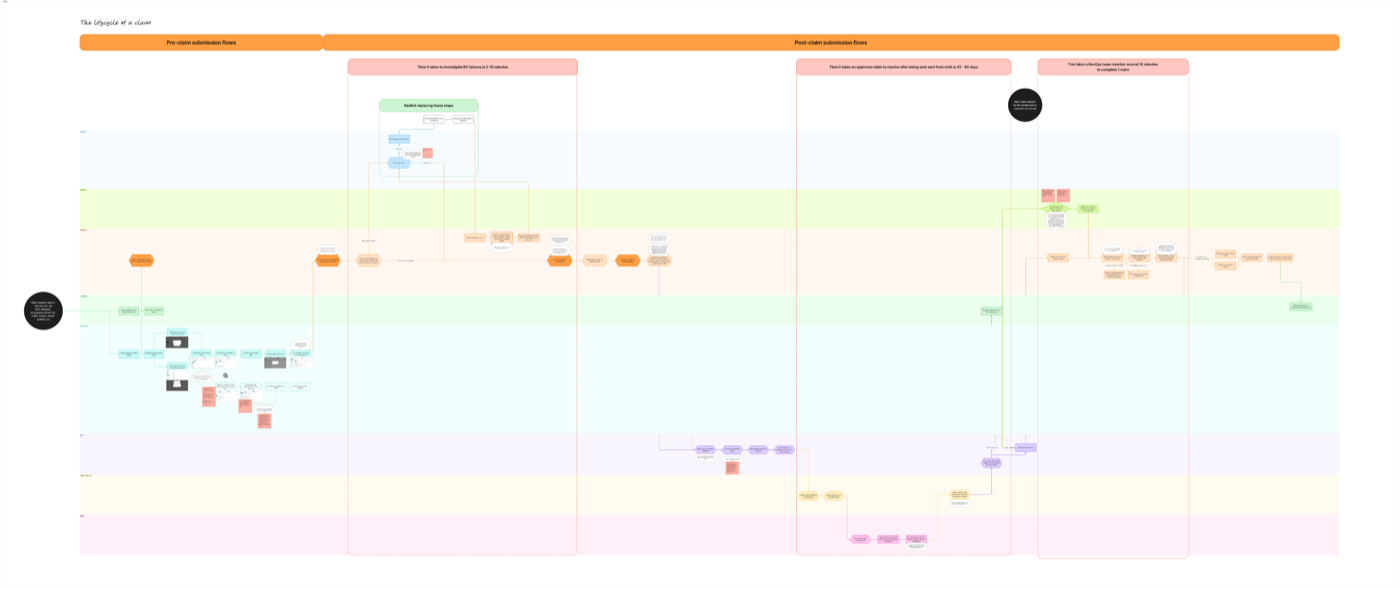
The lifecycle of a client — mapping the full claim journey across client, provider, and system layers to identify where things broke down
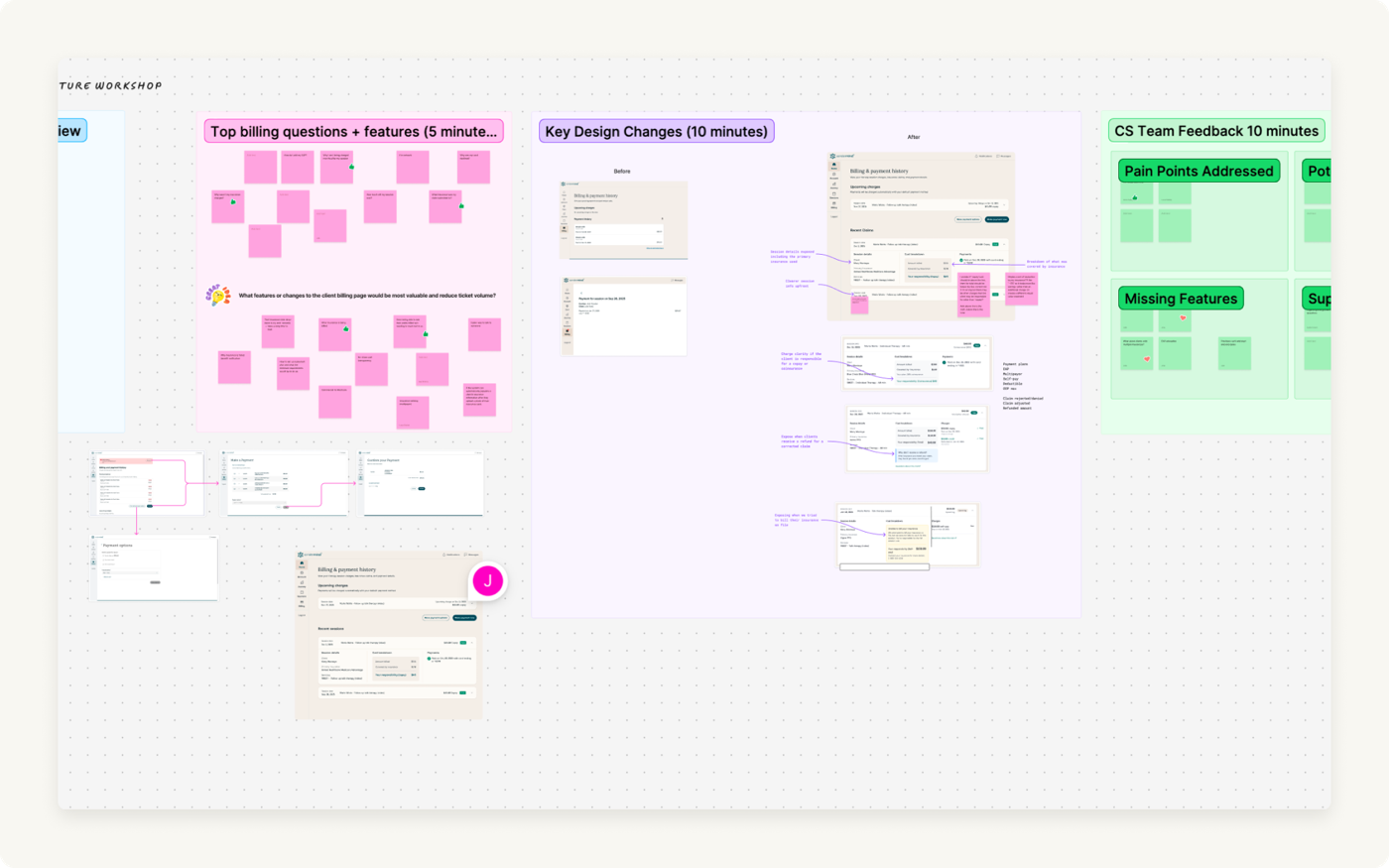
Cross-functional workshop — surfacing top billing questions, CS team feedback, and key design questions before scope was locked
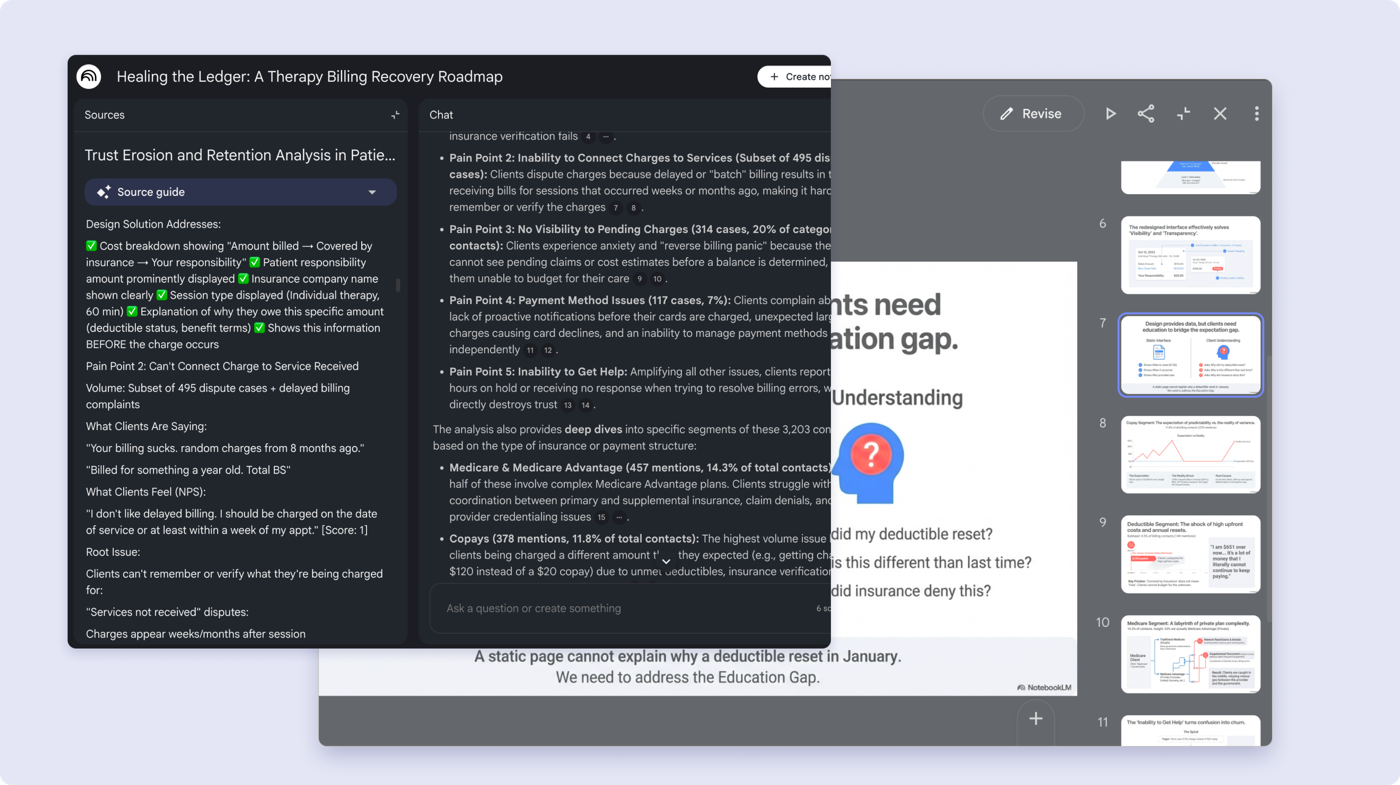
AI-assisted data analysis — Claude clustering 3,203 support tickets alongside the research framing. The AI surfaced categories; the root causes required human interrogation on top.
Quantitative analysis · 3,203 support tickets + 55 NPS verbatims
Why this method
3,203 contacts is too large to read manually without bias. AI-assisted clustering was the only way to get full coverage in the time available. The tradeoff: AI surfaces what clients say, not why — so this required a second pass before the output was usable.
What was found
Two dominant clusters: "Copay & Payment Confusion" (1,629) and "Card on file errors" (1,442). At surface level: two distinct problems. At root: the same cause — a 45-day information blackout between session and charge.
What it didn't answer
Volume tells you what people call about, not how frustrated they are. Tickets also undercount — not every confused client files one. Some just stop rebooking.
Billing comprehension survey
When providers say they "accept insurance" or are "in-network," clients interpret that as "I won't be charged." They don't have a working model of copays vs. deductibles vs. coinsurance. The #1 ask: be able to contact someone immediately when something is confusing — which directly justified the AI support layer.
Competitive analysis · telehealth platforms + insurance portals
Most telehealth platforms are payment-first. Traditional insurance portals use EOB format — billed vs. allowed vs. patient responsibility. I reviewed my own EOBs to pressure-test the language. The most useful insight: clients want the breakdown — what insurance covered, what was my portion, why. That became the core of the processed claim card.
Synthesizing findings
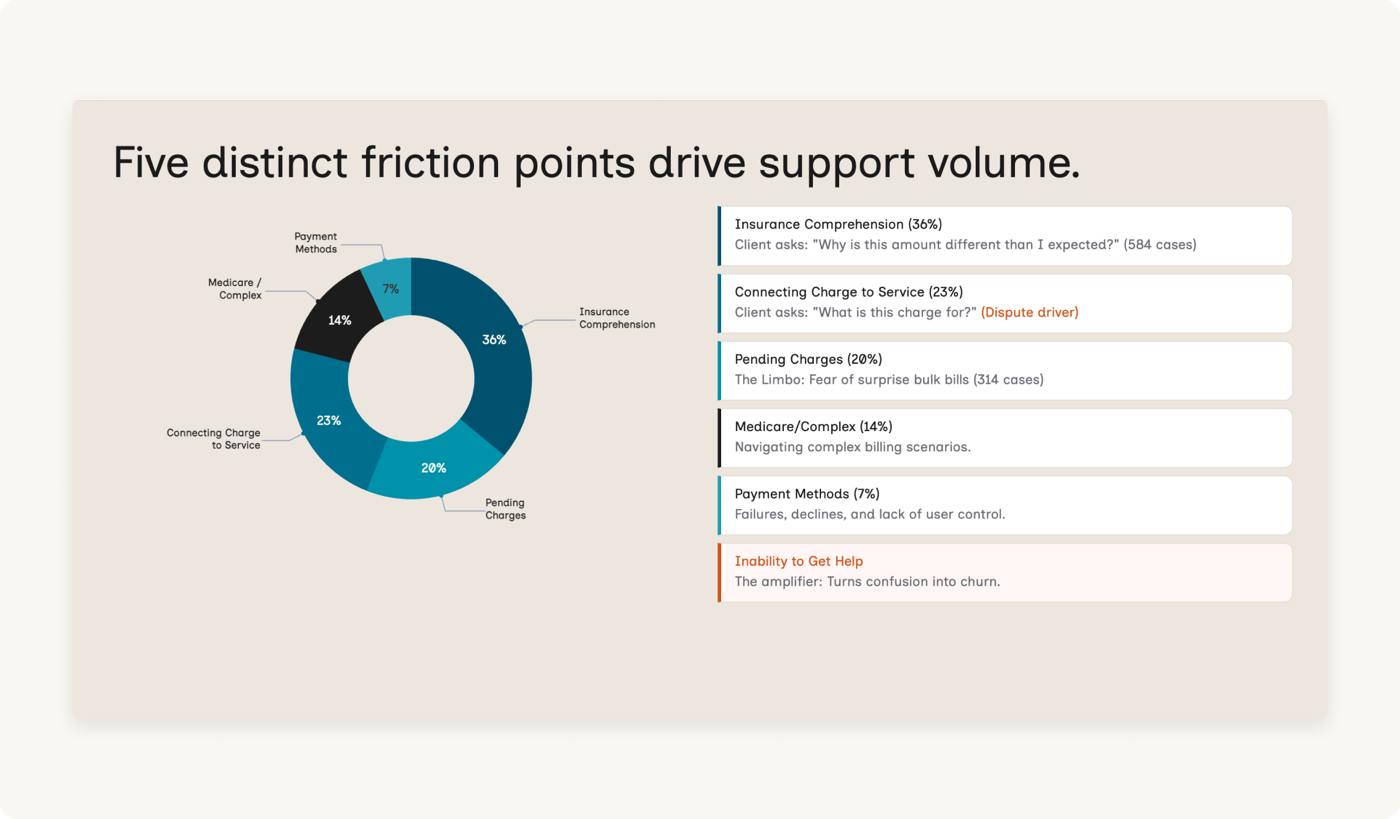
The data didn't just show what clients were calling about — it revealed a structural problem. The billing page was organized around how the backend worked, not how clients thought. Every friction point traced back to the same source: a 45-day gap between session and charge with no information in between. "Inability to get help" wasn't a sixth problem — it was the thing that turned every other problem into churn.
Five friction points driving 3,203 monthly contacts — "Inability to Get Help" identified as the amplifier that turns confusion into churn
The synthesis also surfaced a deeper insight from the comprehension survey: the industry language we all use — "your insurance covers this" — was actively creating wrong expectations before clients even reached the billing page. This wasn't a SonderMind problem. It was a systemic language failure we'd need to design around. That finding changed what the billing page needed to do: not just show the amount, but explain the category.
Billing anxiety is a care access problem. Clients who are stressed about unexpected charges don't rebook — they disengage. As I framed it when presenting to leadership: billing sits at the base of the hierarchy. You can't build a therapeutic relationship on top of financial uncertainty.
Sharing the vision
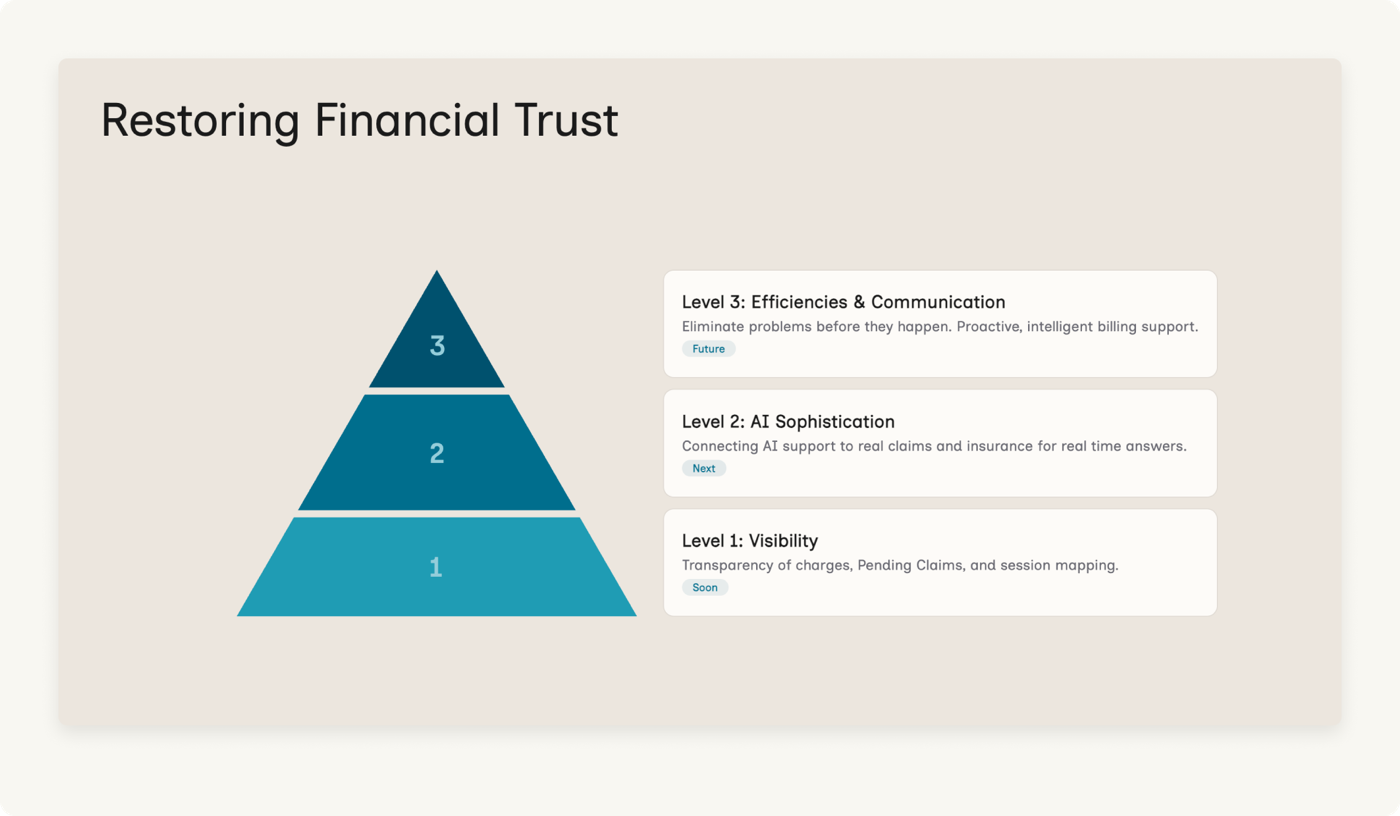
The longer I spent designing claim states, the clearer it became that there would always be a next edge case. Medicare Advantage. EAP billing cycles. VA authorization windows. The answer wasn't designing more states indefinitely — it was a layered strategy. I presented this to leadership as a pyramid: transparency first, then intelligent support, then proactive communication.
Layer 1
Redesign the billing page from payment ledger to claim-first session history. Every session visible from the moment a claim is submitted. Charge type labels. Insurance coverage breakdown. Payment method where clients need it.
Shipped June 9Layer 2
A context-aware AI support agent — available 24/7, educational, connected to the client's actual claim and insurance data. Resolves questions before they become support tickets.
In experiment (5% of users)Layer 3
Eliminate upstream billing confusion before it generates a contact at all. Year-end insurance reminders. Proactive outreach when claims take longer than expected.
Roadmap — leadership alignedDesigns — Phase 1
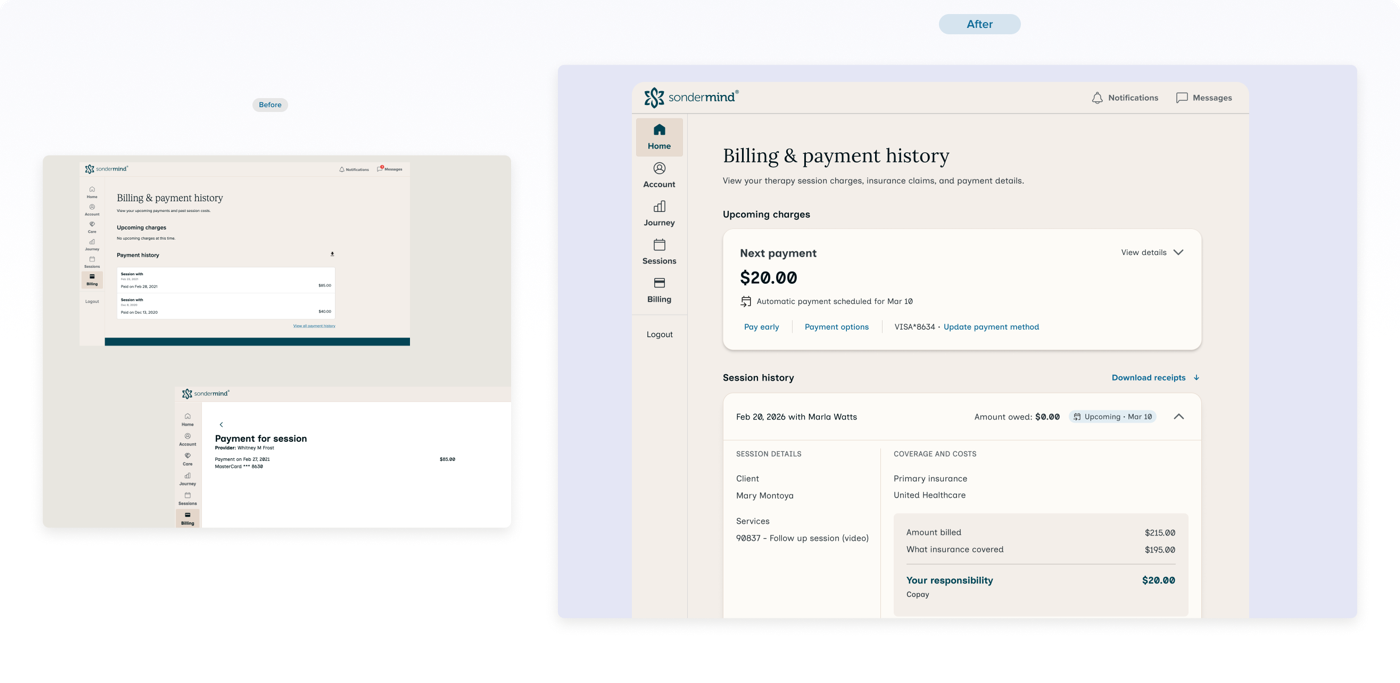
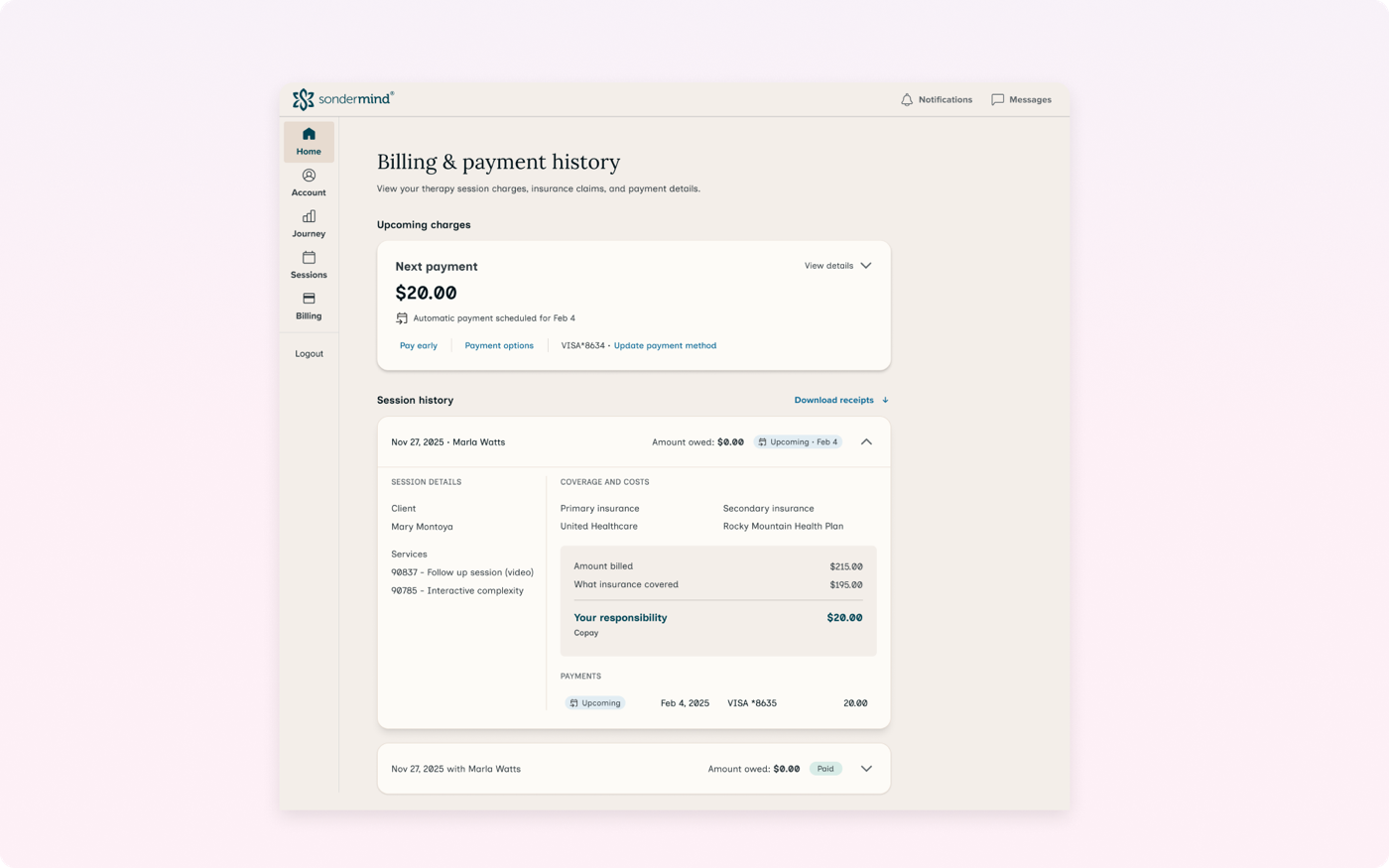
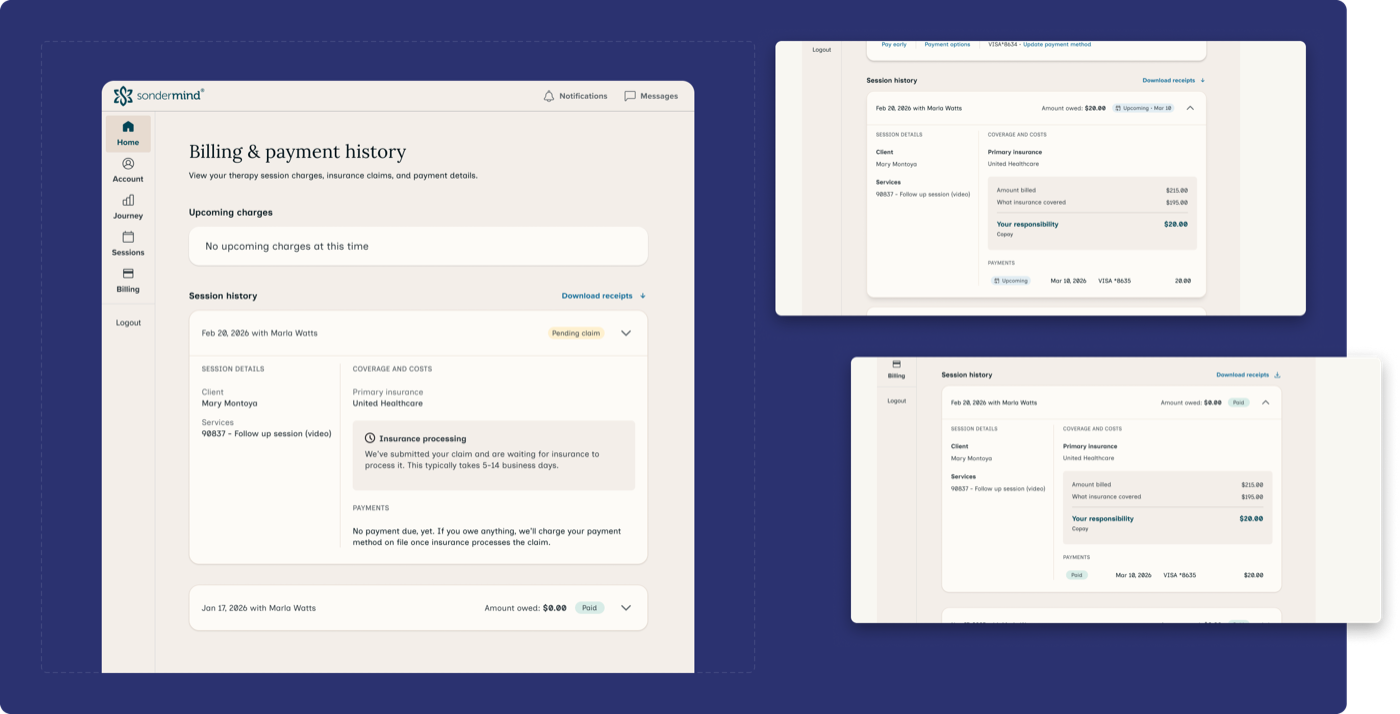
The billing page is now claim-first. Every session is visible from the moment a claim is submitted — not when money moves. Six claim states were designed from scratch to cover the full lifecycle.
Before and after — the old payment-ledger page versus the new claim-first session history
| State | What it shows | Design note |
|---|---|---|
| Processing | Claim submitted, insurance review in progress. Session visible immediately after claim submission. | No timeline visualization — engineering cut this. Status label carries what the animation was supposed to communicate. |
| Processed | Full breakdown: amount billed, insurance covered, charge type label (Copay / Coinsurance / Deductible), patient responsibility. | The charge type label is the most important single design decision — it answers the question clients were calling about. |
| Action Required | Specific ask, one direct path to resolve. | One action per card. Too many options at a moment of anxiety is its own failure mode. |
| Denied | Denial reason, appeal path. | Denial reason language required careful handling — worked with RevOps on approved language before design was finalized. |
| Paid | Receipt-style confirmation. Definitively closed. | The end state clients need to see to trust the system worked. |
| Upcoming | Estimated cost before session. | The anxiety lives before the charge, not after. This is where transparency matters most. |
01
The charge type label answers the question clients were calling about
Clients were calling because they didn't understand why $175 wasn't the $30 copay they expected. The charge type label — Copay / Coinsurance / Deductible — closes that gap. The comprehension survey revealed that "covered by insurance" was actively creating wrong expectations. This label is the correction.
02
Pending claims are visible from day one
Previously nothing appeared until a charge processed — up to 45 days of silence. Now every session shows a claim card the moment it's submitted. Clients can see their session is in the system, even before insurance adjudicates. This alone addressed 20% of support contacts — the "was my session even recorded?" calls.
Engineering constraint: no timeline visualization — the state machine required more backend plumbing than justified at launch. A status label does the work the animation was supposed to do.
03
The full picture, across device sizes
The redesign needed to work across desktop and mobile — clients check their billing on both. The claim card layout stacks cleanly on mobile without losing the charge breakdown. EAP and VA clients, who previously saw an empty page, now see sessions with explicit "$0 — Covered" status. Payment method is surfaced directly on relevant claim cards with a direct update link, eliminating 117+ monthly contacts from clients unable to find where to update their card.
Interactive prototype
Click through the claim states, explore the charge breakdown, and see how the page handles pending vs. processed sessions.
Designs — Phase 2
The #1 ask in the comprehension survey was immediate access to someone who could explain charges. No matter how complete the billing page is, some questions need conversation — because insurance is too variable, and because anxiety at 10pm doesn't wait for business hours.
04
Context-aware, educational, available 24/7
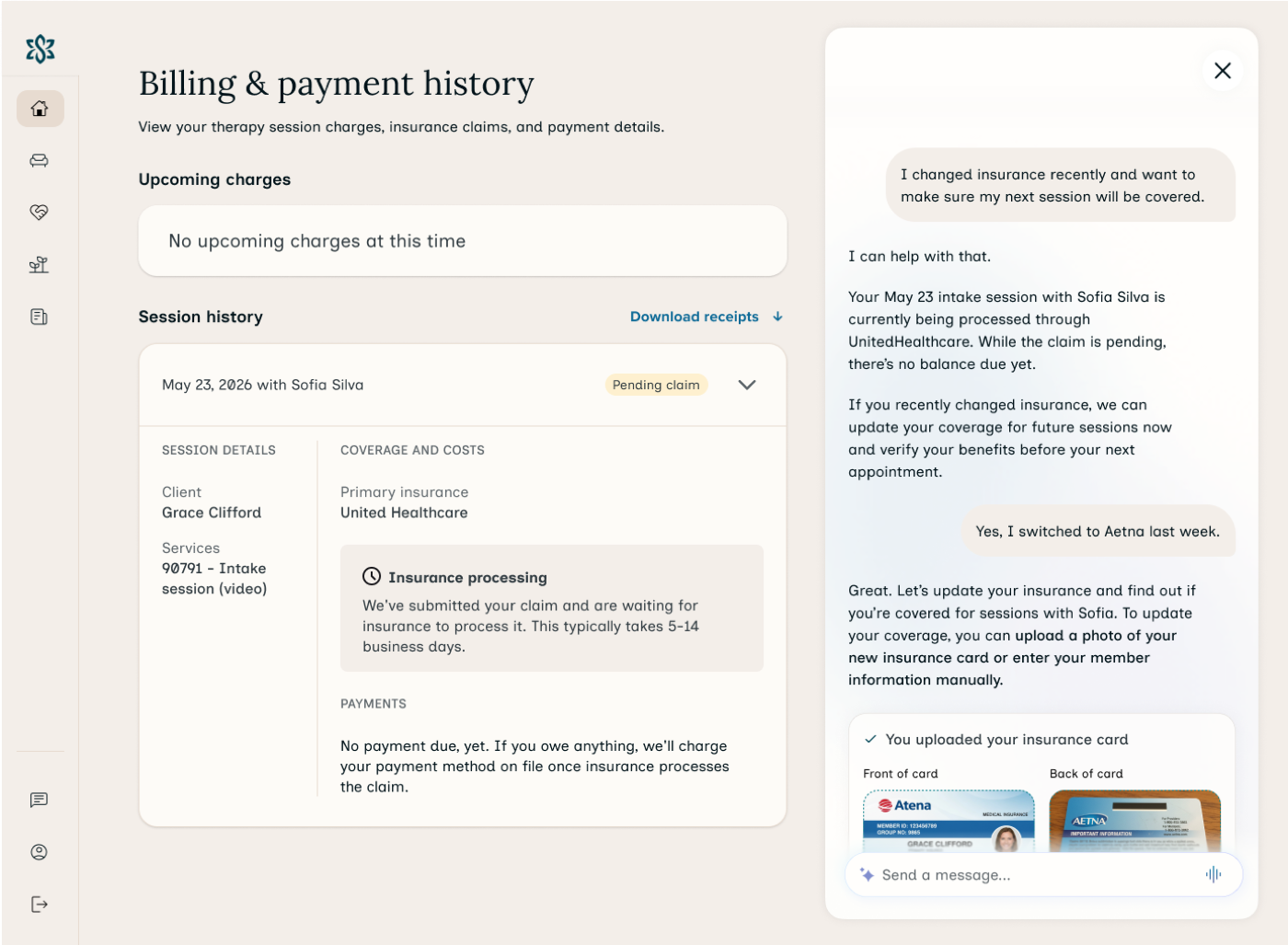
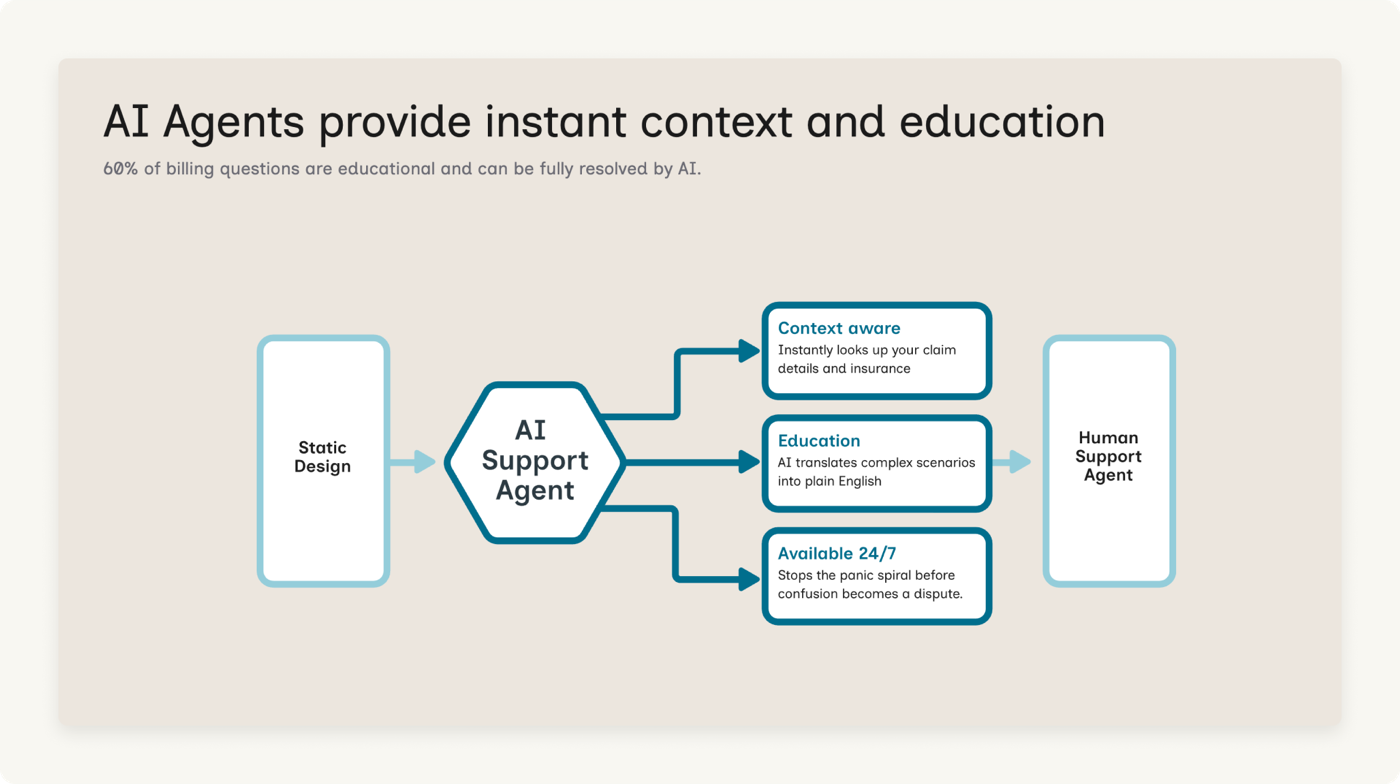
The agent sits between the static billing page and a human support agent — catching the questions the UI can't fully answer. It's designed to be context-aware (connected to the client's actual claim and insurance data), educational (able to explain what a deductible is in plain language), and always available. 60% of billing questions are educational and can be fully resolved without human escalation.
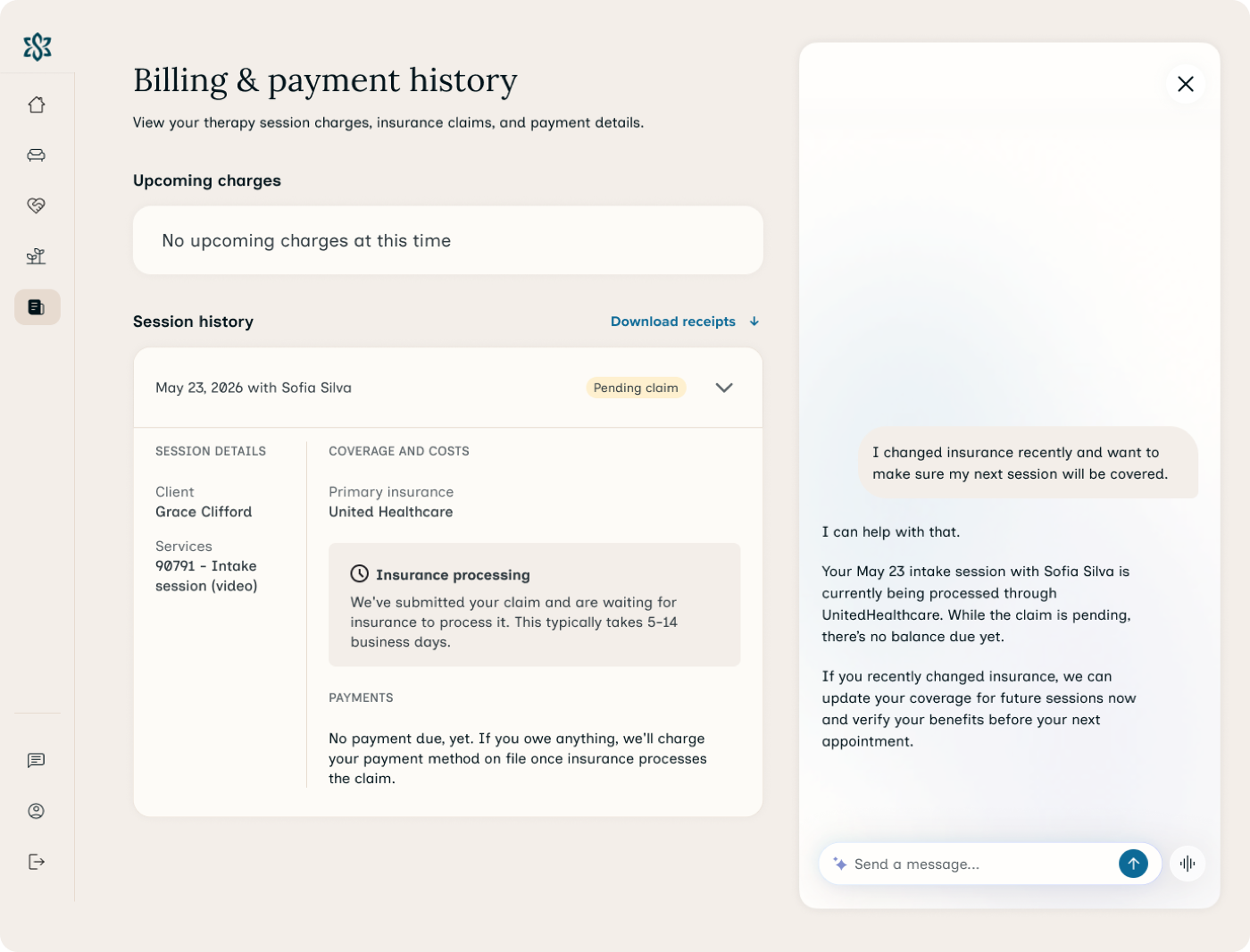
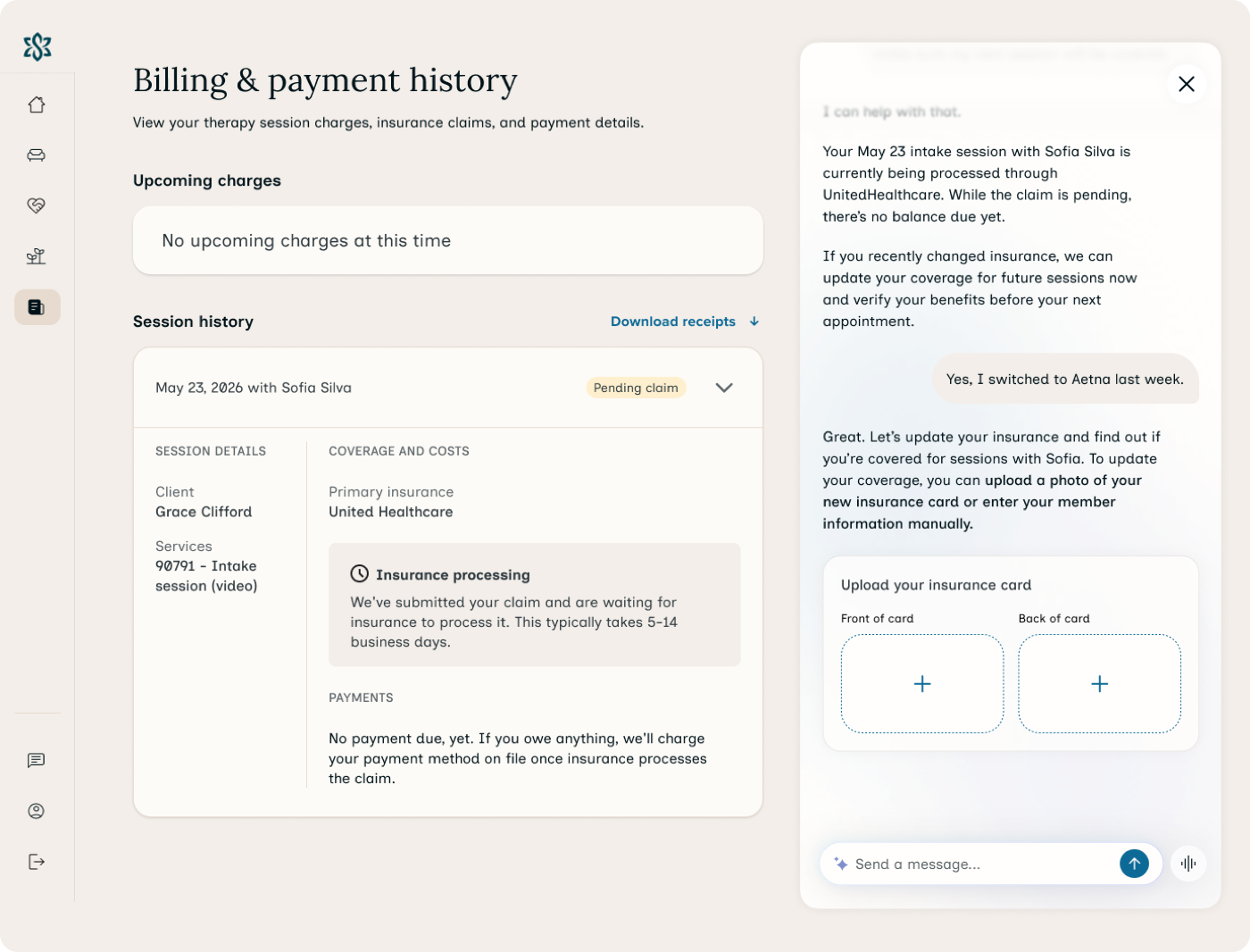
Client asks about a recent insurance change — agent responds with context about the pending claim
Agent guides client through updating their insurance card — resolving the issue without a support ticket
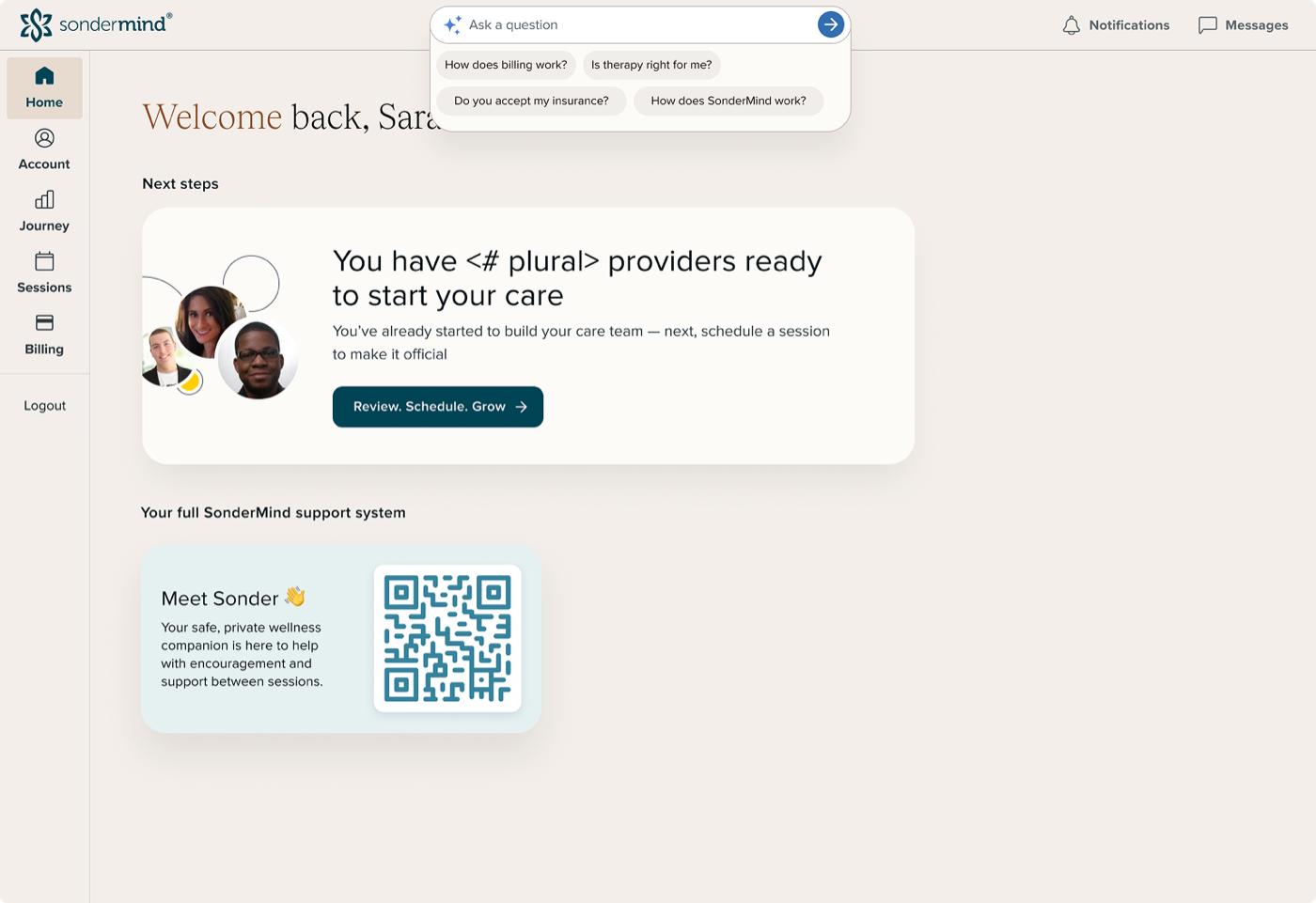
Agent entry point — surfaced in the portal as Sonder AI, accessible from the billing page
The agent launched with general FAQ capability first — not claims-connected responses. An agent that confidently answers a billing question incorrectly is worse than no agent. The agent earns personalization by being reliable at the general level first. Currently live for 5% of users (~600 people); next iteration connects it to real claim and insurance data.
Results
3,203
Billing support contacts/month
Feb 2026 baseline
69%
Detractor rate on billing NPS
Feb 2026 baseline — primary improvement signal
≥10%
Reduction target in billing care coordination cases
Defined success threshold, 60-day window
[STAT]
Billing care coordination case reduction
Add at 30 and 60 days post June 9 launch
Learnings
Claude clustered 3,203 tickets and surfaced "Copay & Payment Confusion" as the top problem. I rejected that framing. The actual cause — a 45-day information blackout — doesn't appear as a category because clients don't know to name it. Interrogating the AI's output instead of accepting it is what turned this from a copy fix into an architectural redesign.
Multiple XFN teams arrived with symptom-level solutions before the research was done. I used the research to redirect those conversations — not to dismiss the ideas, but to place them in the right order relative to root causes. You can only do that credibly if you know the domain well enough to say "we're solving the wrong thing" and be believed.
I held firm on inverting the data model when engineering pushed back — a claim-first UI on a payment-first backend is a visual trick, not a fix. But I accepted the cut of the claim timeline visualization and VA/EAP authorization data without hesitation. There's a real difference between the architectural decision that makes the system work and the features that can ship in a fast follow. The skill is knowing which is which before the conversation starts.